
The end of the year is often a time for summaries and conclusions. Since various companies are now publishing reports on the IT market situation in 2025, I decided to take a look at one of these reports. As I am currently looking for new challenges and trying to find my place in the market, I considered this to be valuable content, both for publication and for my own reading. I invite you to read it.
Data source
As our source, we will use the report from the largest Polish job board for IT positions in Poland.
Justjoin.it currently publishes 15,110 job offers (January 14, 2026). This makes them not only a Polish but also a European leader in terms of the volume of job postings. Based on this, I assume that the results of the report they publish are based on a sufficiently large sample and represent a reliable, averaged picture of the job market as of today.
You can find the report on their website at the following address:
https://justjoin.it/salary-report/
The report is divided into several sections: Job offer statistics, salaries by category, working conditions in the tech industry, and salary statistics. I reviewed each section in turn and will share my thoughts on them with you.
Job offer statistics
The number of job postings broken down by month is quite revealing. There is a clear difference between the months and a certain seasonality is evident.
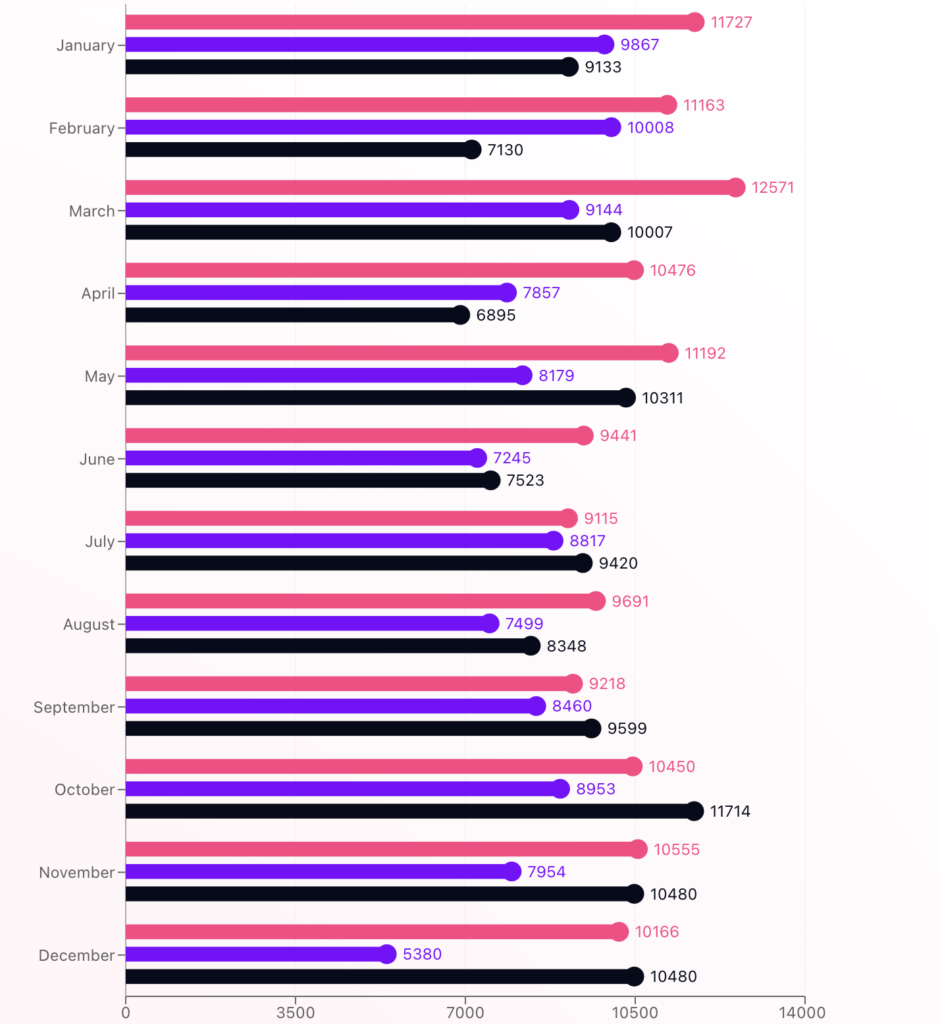
Finding a job is definitely most difficult during the summer and holiday season. Firstly, because there are fewer job openings, and secondly, because recruiters and teams in general are less active.
In terms of technologies, the clear leaders are: Data, JS, and Java.
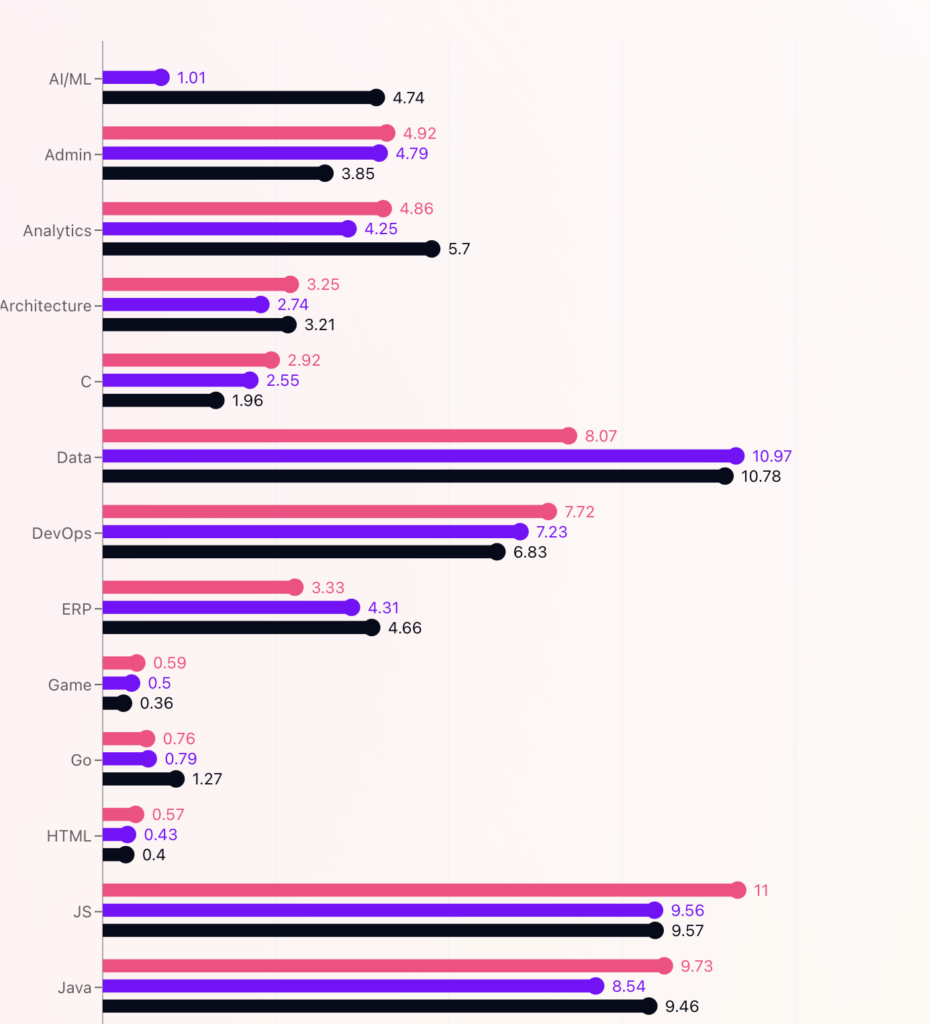
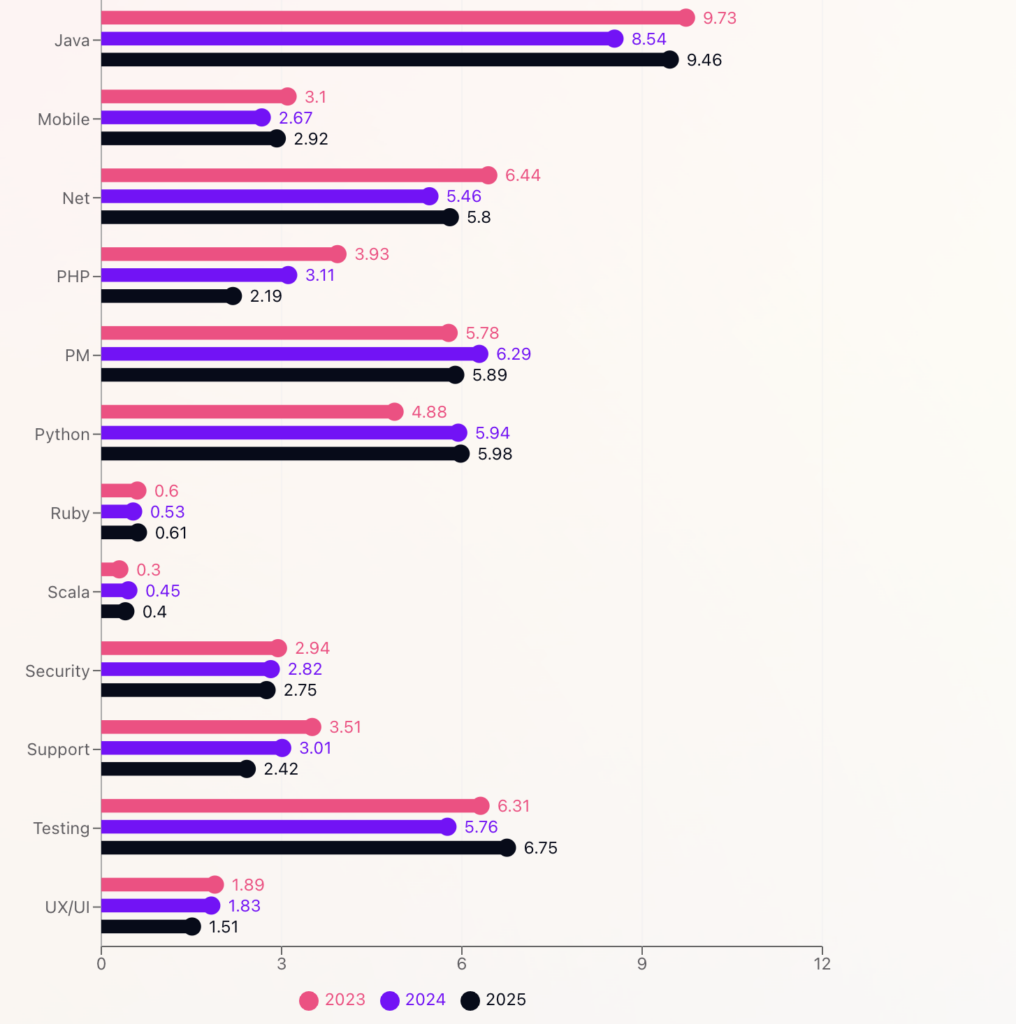
This doesn’t surprise me at all. These technologies and categories have been the most sought-after for years. The data shows a clear upward trend. This is largely due to the development of LLMs (Large Language Models). Companies need to process clean, structured data and want to analyze it with the help of AI. That’s why the number of job openings for Data Engineers and Data Analysts continues to grow.
I’m still a bit surprised by the large number of JavaScript job postings. LLMs code the frontend layer quite efficiently, perhaps thanks to Node.js, whose ecosystem has developed significantly recently. From my perspective, Claude Code or Cursor can write JavaScript code at a much better level than I, as a native backend developer, can manage using examples from the internet and documentation. We need to ask the frontend developers how they manage to avoid being made redundant and how they demonstrate their value to the company. Perhaps there are certain aspects that could be mapped to other areas of software development!
Nobody needs Juniors
That’s sad and difficult for people who have hope for a better life thanks to working in IT. I once wrote an article about entering the market and how the entry barrier to IT is getting higher and higher. I see that this hasn’t changed at all, as the number of job offers for beginners (Juniors) remains close to 5%.
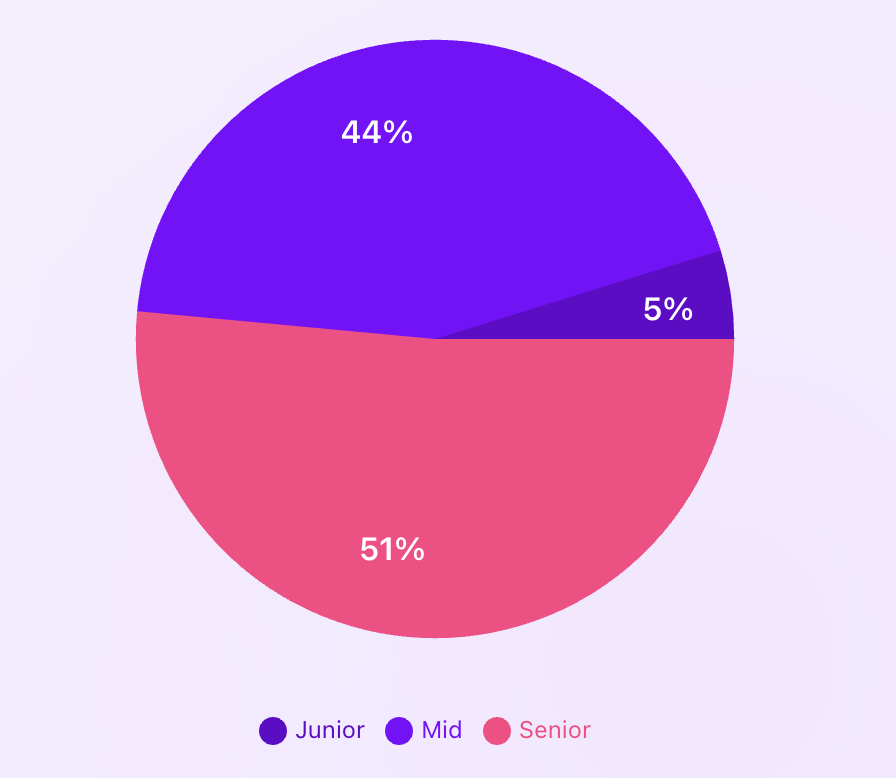
My perspective on this issue is quite controversial. From an employer’s point of view, I think I would hire more junior developers today. Thanks to AI, the learning process is much faster now. If we want to invest in human resources, hiring several juniors (e.g., 3) and one senior is more cost-effective in the long run than hiring two seniors. Although the financial cost might be similar, a senior developer might leave soon, while we have a better chance of retaining a junior developer for a longer period. Especially as the market is slowly transforming into an employer’s market, there’s less risk of the junior employee quickly leaving. I just wonder when employers will understand this. The market seeks immediate returns, which is provided by hiring mid-level and senior developers – they don’t need training. However, in my opinion, this is a mistake.
Remote work
Many companies are now offering hybrid work instead of fully remote work, with the option or requirement to meet team members face-to-face at least once a week. As a remote work enthusiast and a bit of a homebody, I definitely don’t like this change! But seriously, hybrid work is, in my opinion, the golden mean. Especially since we schedule meetings at the office on a specific day. Many problems can be solved better in a specific environment. In my opinion, this trend will continue in the coming years.
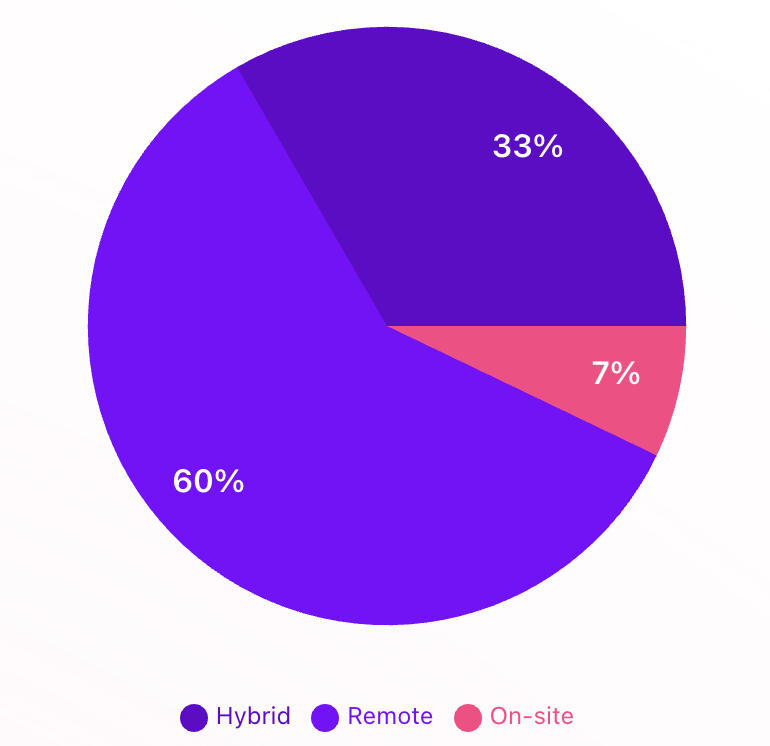
A chart showing the ratio of remote, hybrid, and in-office work. Is a return to the office becoming visible?
Types of contracts
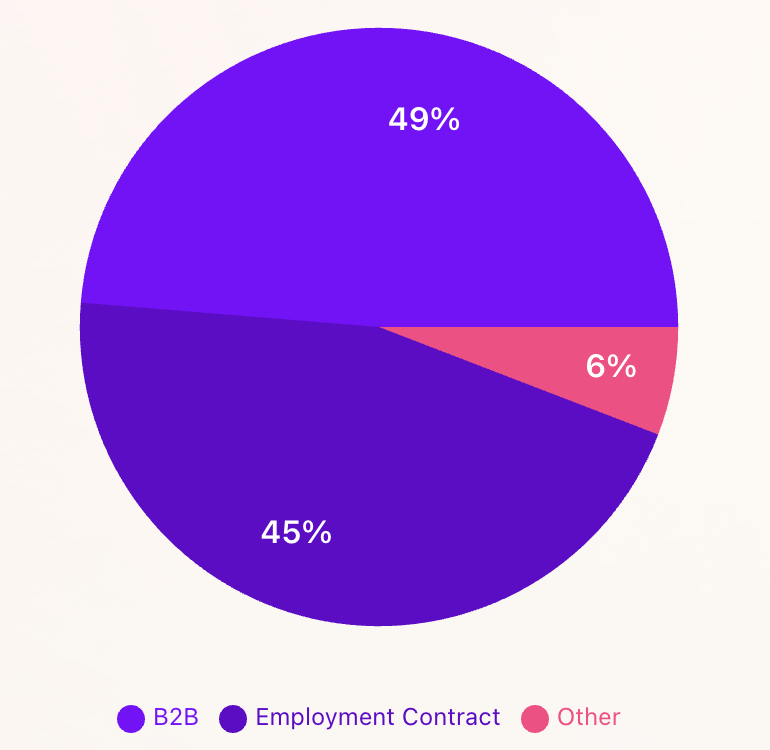
The B2B contract market is quite significant. This is due to substantial tax breaks for sole proprietors in Poland. The effective tax rate decreases from approximately 60% for employees on standard employment contracts (the highest tax bracket already affects mid-level earners) to around 25% for self-employed individuals. This is a considerable relief for household budgets.
Companies, in turn, benefit from this by having an easier way to manage their workforce and are not burdened as much by regulations stemming from labor law, employee rights, collective bargaining agreements, etc.
Salaries
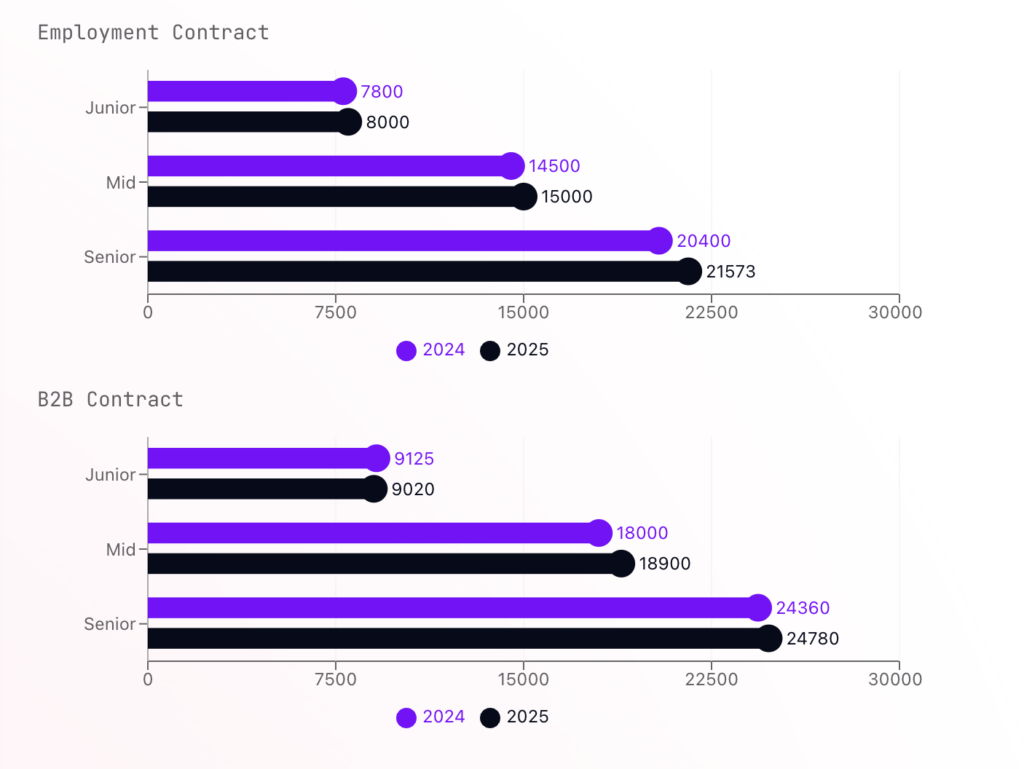
You can find the full range of technologies and specializations here: https://justjoin.it/salary-report/category-statistics. I will only present the most interesting aspects and my opinion.
BOTTOM 3 LOSERS (decrease or smallest increase):
- Support – -4.93% (UoP)
- The biggest decline in the industry.
- Average: 11,250 PLN (employment contract), previously 11,833 PLN
- The lowest salaries in IT
- Net (.NET) – -1.61% (B2B)
- Decline in B2B contracts
- Average: 17,140 PLN (B2B), previously 17,420 PLN
- C – -1.91% (B2B)
- A slight decrease
- Average: 17,530 PLN (B2B), previously 17,871 PLN
TOP 3 WINNERS (highest growth):
- Scala – +58.83% (employment contract)
- The biggest growth in the entire IT industry.
- Average: 22,025 PLN (employment contract), previously 13,867 PLN
- Go (Golang) – +35.67% (employment contract)
- The second largest increase
- Average: 22,250 PLN (employment contract), previously 16,400 PLN
- The highest average salary in the industry!
- ERP – +14.88% (B2B)
- The biggest increase was in B2B contracts.
- Average: 20,927 PLN (B2B), previously 18,217 PLN
Losers
As we can see above, .NET developers working under B2B contracts are definitely the least satisfied. Those on traditional employment contracts saw a small increase of 3.13%, which is also not very encouraging. Could the .NET sector already have a fully saturated market? The Support sector recorded the same, or even worse, results, making it the lowest-paid sector in IT. Additionally, due to automation and the implementation of AI in many company processes, we are seeing both a decrease in the number of job offers and lower salaries (due to the low entry barrier to IT Support compared to other sectors). Nevertheless, the salaries there are still quite decent.
Support’s market share of job postings fell from 3.1% to approximately 2.4%. A strong correlation is evident here.
Winners
Among the languages experiencing growth, Scala and Go stand out, followed to a lesser extent by ERP. The increase in salaries for these “newer” and presumably less mature programming languages is astonishing. The market hasn’t yet had time to properly value the skills of these programmers, or perhaps the demand is so high that it distorts and strongly influences the pricing of services (urgency, the need for rapid implementation).
It should be added that Scala accounts for only 0.4% of all job postings, so the volume may also slightly influence the dynamics of wage growth.
Where can you earn the most money?
Regarding the highest salaries recorded on justjoin.it, the case of at least one offer is particularly interesting: 99,490 PLN – WOW, earning 100k a month – that would be something! I probably don’t need to mention that the demand for neural network models and AI specialists is constantly growing, and such incredibly high salaries are the best proof of this, in my opinion.
Generally, we earn the best average salaries in the following areas:
TOP 3 – Highest average earnings (on B2B contracts):
Security – PLN 20,465
Scala – 21,487 PLN
ERP – 20,927 PLN
We see that 2 out of the 3 highest-paying categories are the same ones that are showing an upward trend year-on-year. I’m a little surprised by the absence of AI/ML-related specializations in this ranking. Perhaps it’s still too early. I’m very curious to see how average salaries in the AI sector will change in what I consider to be the crucial year of 2026.
Summary
2026 will certainly be a year of change. The AI revolution is slowly making its presence felt in the job market. Coding tools are becoming more mature and reliable. From my perspective (the PHP bubble), the market is becoming more professional; interviews require more than before, and there are many more applicants for each position. The quality of these candidates is another matter, but unfortunately, that’s beyond my control since I don’t personally hire anyone (and don’t intend to in the near future).
Outside of my immediate circle, it’s difficult to assess the situation definitively. The market is certainly stabilizing and the dynamics and growth are no longer as strong as they were during the 2015-2022 period. In terms of hard data, the market has been slowly stabilizing for the past three years. For more information, I encourage you to read the full report. I’m sharing the link again: https://justjoin.it/salary-report/.
I’m also curious about your opinion on this report: does it reflect what you see in your circles? And to answer the question in the title: No, the Eldorado is not over yet, but I have a feeling that technological changes may give it more momentum. Then it could really go in two directions: either the market will need more hands to meet the demand for software, or part of the market will be absorbed by AI tools. Everything is in the hands of the owners of technologies related to LLMs and the owners of capital – after all, they are the ones who decide every day whether Damian from Gdańsk or Janek from Gliwice will have something to do.
I hope that new technological capabilities will allow us to create faster and better. However, it’s possible that customers (individual consumers) will be able to solve many problems without the need for a programmer. In that case, it’s best to have a plan B. And do I have a plan B? Of course I do. I see my opportunities in the areas of Data and Architecture. That’s probably where the profit margin disappearing from the programming market will go, if such a phenomenon occurs.
On the other hand, I recommend that everyone learn about AI tools and try to keep up with the market. The ability to learn and an open mind will always give us an advantage in the market. If only the strongest survive in the jungle, then that strength will certainly be the ability to work with the help of AI in the coming years.
I wish all readers good luck on this path and professional fulfillment, regardless of the technology or sector. After all, at the end of the day, it’s just a job, and it’s important to first and foremost earn a living from it, and secondly, to have at least some fun doing what we do. The only certainty is change, and that’s the thought I’d like to leave you with.
Thanks!
